
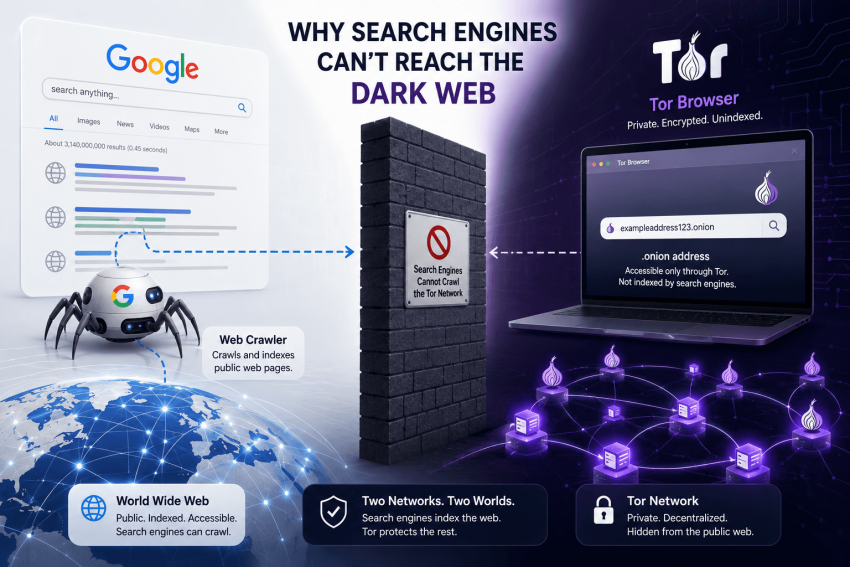
How Search Engines Discover Websites
Before a webpage can appear in Google, Bing, or other search engines, it first needs to be discovered. Search engines don’t automatically know that a new website exists. Instead, they rely on sophisticated automated programs, commonly known as web crawlers or search engine bots, to explore the internet and identify new or updated pages.
These crawlers work continuously by visiting billions of web pages and following links from one page to another. Every time a crawler encounters a new webpage, it evaluates the content and determines whether the page should be added to the search engine’s index. If the page meets the necessary criteria, it becomes eligible to appear in search results when users search for relevant topics.
Web Crawlers: The Internet’s Explorers
Search engines use automated software to navigate the web. Google’s crawler is called Googlebot, while Microsoft’s Bing search engine uses Bingbot. These bots operate around the clock, requesting web pages much like a regular browser would.
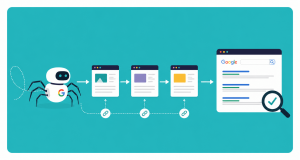
When a crawler visits a page, it examines the page’s content, follows internal and external links, and discovers additional pages that may also deserve to be indexed. This process allows search engines to continuously expand and update their understanding of the public web.
Links Help Crawlers Find New Pages
One of the most important ways search engines discover new content is through hyperlinks. When one website links to another, crawlers can follow that connection and explore the newly discovered page.
This interconnected structure is one of the reasons the World Wide Web is called a “web.” Every publicly accessible link creates another pathway that search engines can use to discover content. Pages that receive links from multiple trusted websites are generally easier for search engines to find than isolated pages with no incoming links.
XML Sitemaps Provide a Roadmap
Many websites also publish an XML sitemap, which is a structured file listing the important pages the site owner wants search engines to crawl.
Although search engines can often discover pages by following links alone, XML sitemaps help ensure that valuable content isn’t overlooked. They can also provide additional information, such as when a page was last updated or how frequently its content changes.
Robots.txt Guides Search Engine Crawlers
Before crawling a website, search engines usually check a file called robots.txt. This file tells crawlers which parts of a website they are allowed to access and which sections should be avoided.
For example, website owners may prevent search engines from crawling administrative pages, duplicate content, or private areas that aren’t intended to appear in search results. While reputable search engines generally respect these instructions, robots.txt is only a guideline and should not be considered a security feature.
Google’s Search Central documentation on robots.txt explains how compliant search engine crawlers use the file to understand which areas of a website they are allowed to crawl.
From Crawling to Indexing
Discovering a webpage is only the first step. After a crawler collects information about a page, the search engine analyzes its content, structure, and relevance before deciding whether to include it in its searchable index.
Only pages that have been successfully indexed can appear in search results. If a page cannot be discovered or crawled in the first place, it has little or no chance of becoming visible through traditional search engines.
What Does Search Engine Indexing Mean?
Many people use the terms crawling and indexing as if they mean the same thing. They don’t. Crawling is how a search engine discovers a webpage. Indexing is what happens after that discovery.
Think of a search engine as a massive digital library. Before a book appears on the shelf, someone must first find it, review it, and decide where it belongs. Search engines follow a similar process before they display a webpage in search results.
Google also explains the difference between crawling and indexing in its Search Central guide to crawling and indexing, noting that a page must first be discovered before it can become eligible to appear in search results.
Crawling Comes First
The process starts when a search engine crawler, such as Googlebot or Bingbot, visits a webpage. The crawler reads the page, follows its links, and collects information about its content.
If the crawler cannot access the page, the process stops there. The page cannot move to the next stage because the search engine never gathered enough information about it.
Rendering the Page
Modern websites often rely on JavaScript, images, videos, and other dynamic elements. After crawling a page, search engines try to render it much like a visitor’s web browser would.
Rendering helps the search engine understand what users actually see. It also reveals important content that may not appear in the page’s raw HTML.
Storing Information in the Index
Once a page has been crawled and rendered, the search engine decides whether it should add the page to its index. The index is a massive database that stores information about billions of webpages.
If a page enters the index, it becomes eligible to appear in search results. If it doesn’t, users are unlikely to find it through Google or Bing, even if the page is publicly available.
Ranking Happens Last
Indexing does not guarantee that a page will appear at the top of search results. Before showing a page, search engines compare it with other relevant pages and evaluate hundreds of ranking signals.
These signals may include content quality, relevance, page experience, website authority, and many other factors. The search engine then decides where the page should appear for a specific search query.
Crawling vs. Indexing: What’s the Difference?
Although the terms often appear together, they describe two different stages of the same process.
- Crawling means a search engine discovers and examines a webpage.
- Indexing means the search engine stores information about that page in its searchable database.
A page can be crawled without being indexed. However, a page cannot be indexed unless the search engine crawls it first.
This difference becomes important when discussing the dark web. As you’ll see in the next section, traditional search engines struggle to crawl onion services in the first place. Without crawling, indexing simply cannot happen.
What Makes the Dark Web Different?
To understand why search engines cannot index the dark web, you first need to understand how the dark web itself works. Unlike the public web, it doesn’t rely on the same infrastructure that powers most websites on the internet.
Instead, the dark web operates on a separate network designed to prioritize privacy and anonymity. That difference changes how websites are accessed, discovered, and shared.
The Tor Network Powers the Dark Web
Most dark web websites run on the Tor network, a decentralized system that helps protect users’ identities by routing internet traffic through multiple volunteer-operated servers around the world.
This process hides a user’s IP address and makes it much harder to trace where the traffic originated. Instead of connecting directly to a website, users connect through several encrypted relays before reaching their destination. If you’re unfamiliar with the Tor Browser or how onion websites work, our guide on How to Browse Onion Sites Securely with Tor explains the process in more detail.
The Tor network was built to improve privacy, not to replace the public internet. Many journalists, researchers, activists, and privacy-conscious individuals use it to reduce online tracking and protect sensitive communications.
According to Tor Project’s explanation of onion services, .onion addresses exist within the Tor network and provide a way to access services without relying on the public Domain Name System (DNS).
Onion Services Don’t Work Like Regular Websites
Websites on the Tor network are known as onion services. Unlike traditional websites, they don’t use familiar domain names such as .com, .org, or .net. Instead, they use long .onion addresses that are generated through cryptographic methods.
These addresses exist only within the Tor network. As a result, a standard web browser cannot connect to them directly.
This design allows both visitors and website operators to communicate without exposing each other’s network locations.
A Different Network Architecture
The public web depends on globally accessible servers, public IP addresses, and the Domain Name System (DNS) to help users and search engines locate websites.
The Tor network follows a different model. Onion services don’t publish their locations through the public DNS. Instead, Tor uses its own mechanisms to connect users with hidden services while keeping their locations private.
Because of this architecture, onion websites remain isolated from the systems that traditional search engines rely on every day.
You Need the Tor Browser to Access Onion Sites
Most web browsers, including Chrome, Firefox, Edge, and Safari, cannot open .onion addresses on their own.
To visit an onion service, users typically need the Tor Browser. It connects directly to the Tor network and understands how to locate and communicate with onion services securely.
Without that connection, a browser has no way to reach websites that exist only inside the Tor network. The official Tor Browser documentation explains how the browser connects users to the Tor network and enables access to onion services that standard web browsers cannot reach.
No Public DNS Means Less Discoverability
On the public web, search engines use the Domain Name System (DNS) as one of many ways to discover and verify websites.
Onion services don’t appear in the public DNS. They exist only within the Tor network and don’t advertise themselves in the same way as traditional websites.
This is one of the biggest reasons search engines struggle to discover dark web content. If a website doesn’t exist within the public internet’s normal infrastructure, traditional search engine crawlers have no straightforward path to find it.
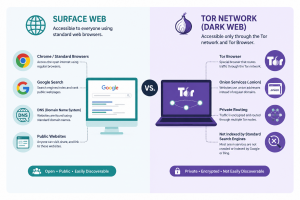
Why Search Engines Cannot Crawl Most Onion Websites
Traditional search engines depend on a predictable process to discover new webpages. They follow links, use public internet infrastructure, and continuously crawl websites that anyone can access with a standard web browser.
Onion websites work differently. Their private architecture prevents search engine crawlers from discovering and accessing them in the same way. As a result, most onion services never become part of Google’s or Bing’s searchable index.
No Public DNS Records
Every public website relies on the Domain Name System (DNS) to connect a domain name with a server on the internet. Search engines use this public infrastructure when discovering and crawling websites.
Onion services don’t use the public DNS. Instead, they rely on the Tor network’s own directory system to locate hidden services.
Because these websites never become part of the public DNS, traditional search engine crawlers have no direct path to discover them.
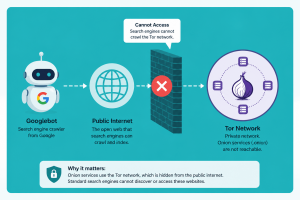
Googlebot is designed to crawl the public web rather than the Tor network
Googlebot was built to crawl the public web. It requests webpages over standard internet protocols and expects websites to respond through the public internet.
Onion services exist inside the Tor network. Reaching them requires a Tor-enabled connection, something Googlebot does not use during its normal crawling process.
Without access to the Tor network, Googlebot cannot visit onion websites, read their content, or evaluate them for indexing.
Most Onion Sites Have Very Few Incoming Links
Search engines discover billions of webpages by following hyperlinks from one site to another. Every public link creates another opportunity for a crawler to find new content.
Most onion websites receive very few public links. Many don’t appear on the surface web at all, while others intentionally avoid linking to one another.
With so few pathways leading to these websites, search engine crawlers have little chance of discovering them naturally.
Many Sites Block Automated Crawlers
Some website owners want search engines to crawl their content because it helps attract visitors. Many onion service operators prioritize privacy over visibility.
Privacy often takes priority over visibility. To reduce unwanted attention, some operators limit automated requests, restrict access, or avoid exposing their websites to systems that behave like search engine crawlers.
These choices make onion websites even harder for traditional search engines to explore.
Constantly Changing Onion Addresses
Many onion services change their addresses over time. Some migrate to new domains after software updates, while others create replacement addresses to improve security or reduce unwanted traffic.
In other cases, websites disappear completely or return under a different onion address.
Because the dark web changes so frequently, even a crawler that somehow discovered an onion website could struggle to keep its records accurate. This constant change makes reliable indexing far more difficult than it is on the public web.
How Dark Web Search Engines Discover Onion Sites
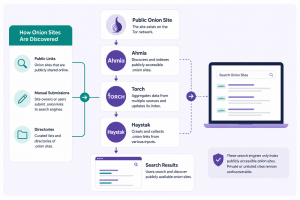
Although traditional search engines cannot crawl most onion websites, that doesn’t mean every onion service remains completely hidden. Several search engines built specifically for the Tor network attempt to discover and organize publicly available onion pages.
Unlike Google or Bing, these services operate on a much smaller scale. They don’t index the entire dark web, and they don’t claim to. Instead, they collect information from publicly accessible onion services using methods that work within the Tor ecosystem.
They Focus on Publicly Accessible Onion Services
Dark web search engines generally index only onion websites that allow public access. If a website requires an invitation, a password, or special authentication, it usually won’t appear in their search results.
This means their indexes represent only a small portion of the overall Tor network.
Some Sites Are Found Through Manual Discovery
Unlike the public web, where automated crawlers discover billions of pages every day, many onion websites are found manually.
Researchers and privacy-focused projects may discover publicly available onion services through trusted directories, publicly shared resources, or direct submissions. Search engine operators may then review these websites before deciding whether to include them in their index.
User Submissions Also Play a Role
Some dark web search engines allow website owners or users to submit onion addresses for review.
After receiving a submission, the search engine may verify that the website is publicly accessible before adding it to its database. This process helps expand coverage without relying entirely on automated discovery.
Examples of Dark Web Search Engines
Several search engines have attempted to organize publicly available onion services over the years.
- Ahmia focuses on indexing publicly accessible onion websites while filtering content that violates its policies.
- Torch is one of the oldest search engines designed for onion services and maintains a large directory of publicly available pages.
- Haystak combines automated discovery with other methods to build its searchable database of onion websites.
Each service uses its own approach, so their search results often differ from one another. We also have a detailed guide covering several dark web search engines, including how they discover publicly available onion services and their limitations.
Their Coverage Has Important Limits
Even the most established dark web search engines index only a fraction of the Tor network.
Many onion websites remain private, disappear without notice, change their addresses, or intentionally avoid being listed. Others block crawlers or exist only for a short period before going offline.
As a result, no dark web search engine provides a complete view of the Tor network. Their indexes are constantly changing and represent only the publicly discoverable portion of available onion services.
Why Many Onion Websites Remain Completely Invisible
Even the most established dark web search engines index only a small portion of the Tor network. Many onion websites never appear in search results because their operators don’t want them to be publicly discoverable.
Unlike the public web, where visibility often brings more visitors, many onion services prioritize privacy over exposure. They intentionally limit who can find or access their websites.
Invitation-Only Services
Some onion websites accept only invited users. Visitors may need a referral, an invitation code, or approval from an administrator before they can access the service.
Since these websites aren’t open to the public, search engines have little or no opportunity to discover or index them.
Private Communities
Many online communities use onion services to provide a more private environment for their members. These communities often share their addresses only within trusted groups instead of publishing them on public websites.
Because the links remain private, search engine crawlers rarely discover these services.
Temporary Websites
Not every onion service stays online for years. Some exist only for a short period before disappearing, while others move to a new address or shut down completely.
This constant change makes it difficult for search engines to keep their indexes accurate. A website that appears today may no longer exist tomorrow.
Password-Protected Pages
Some onion services require users to sign in before they can view any content.
Search engine crawlers generally cannot access pages that sit behind login forms or authentication systems. Without access to the content, they have nothing to crawl or index.
Deliberately Hidden Services
Some website operators take additional steps to avoid public visibility. They may choose not to share their onion address outside a small group of trusted users or avoid listing it in directories and search engines.
For these services, remaining hidden is part of their design. As a result, they can operate for long periods without appearing in any searchable index.
Can Google Ever Index the Dark Web?
The short answer is no—not in the way it indexes the public web.
Google’s search engine is designed to crawl websites that are publicly accessible through the internet. Since onion services exist inside the Tor network and don’t use the public web’s infrastructure, Google cannot crawl or index all.onion pages.
However, there are a few situations where information about an onion service may appear in Google Search.
Public Mirrors Can Be Indexed
Some organizations publish a public version of their website alongside an onion service. These public websites, often called mirrors, contain similar or identical information but run on a standard domain such as .com or .org.
Because these websites are publicly accessible, Google can crawl and index them like any other webpage.
Surface-Web Versions of Onion Projects
Several privacy-focused organizations maintain both a traditional website and an onion service. The public website helps users discover the project, while the onion version offers an additional way to access it through the Tor network.
Google can index the public website because it exists on the surface web. The corresponding onion service, however, remains outside Google’s normal crawling process.
Why Onion Pages Stay Outside Google’s Index
Google’s search engine depends on publicly accessible websites, standard internet protocols, and the ability to crawl pages directly.
Onion services don’t meet those requirements. They exist only within the Tor network, use .onion addresses instead of public domains, and don’t rely on the public DNS that Google uses to discover websites.
As a result, the vast majority of onion pages remain outside Google’s searchable index.
Common Myths About Dark Web Search
The dark web is often misunderstood. Movies, news headlines, and online discussions have created several myths about how it works. Understanding the facts helps explain why search engines struggle to index onion websites.
Myth: Google Indexes Everything
Fact: Google indexes only a portion of the public web.
Millions of webpages remain outside Google’s index for many reasons. Some block search engine crawlers, others require authentication, and many simply haven’t been discovered. Onion services add another layer of complexity because they exist outside the public web altogether.
Myth: Every Onion Website Appears in Search Engines
Fact: Most onion websites never appear in any search engine.
Even search engines built specifically for the Tor network cover only a limited number of publicly accessible onion services. Private websites, invitation-only services, and constantly changing addresses prevent complete indexing.
Myth: Hidden Means Illegal
Fact: Not every hidden website is associated with illegal activity.
Many people use onion services for legitimate reasons, including protecting privacy, avoiding censorship, conducting academic research, and enabling secure communication. The technology itself is neutral, and its purpose depends on how individuals choose to use it.
Myth: The Deep Web and the Dark Web Are the Same
Fact: The deep web and the dark web are different parts of the internet.
The deep web includes any content that search engines cannot access, such as email inboxes, online banking portals, private databases, subscription services, and password-protected websites.
The dark web is a much smaller section of the deep web that requires specialized software, such as the Tor Browser, to access onion services.
Although every dark web page is part of the deep web, only a small percentage of the deep web belongs to the dark web.
Why This Matters for Privacy and Security
The dark web’s architecture makes it difficult for traditional search engines to crawl and index onion services. While this limits discoverability, it also supports one of the Tor network’s primary goals: protecting user privacy.
Understanding this balance helps explain why the Tor network was designed differently from the public web.
Privacy by Design
The Tor network wasn’t built to hide websites from search engines. It was designed to improve privacy by reducing the amount of information that websites, internet service providers, and other third parties can collect about users.
By routing traffic through multiple encrypted relays and using onion services, the network helps protect both visitors and website operators from unnecessary exposure.
Reduced Discoverability
On the public web, visibility is often a goal. Website owners optimize their pages so search engines can find and rank them.
Many onion services take the opposite approach. They limit public exposure by avoiding traditional web infrastructure, which naturally reduces their visibility in search engines.
This reduced discoverability is a result of the network’s design rather than a flaw in how search engines operate.
Benefits for Privacy-Focused Users
For some people, online privacy is more than a preference—it’s a necessity.
Journalists may use onion services to communicate with confidential sources. Human rights organizations may publish information in regions where internet access is heavily monitored. Researchers and security professionals also use the Tor network to study online threats or protect sensitive communications.
In these situations, reducing public visibility can help lower the risk of unwanted tracking or surveillance.
Privacy Doesn’t Guarantee Complete Anonymity
Although the Tor network provides important privacy protections, it does not guarantee complete anonymity.
Users can still reveal personal information through their own actions, such as sharing identifying details, downloading unsafe files, or signing in to personal accounts while using the network.
Protecting privacy requires more than technology alone. Safe browsing habits, good security practices, and an understanding of online risks all play an important role.

Frequently Asked Questions
Can Google search the dark web?
No. Google cannot search or index most of the dark web because onion services operate within the Tor network instead of the public internet. Google’s crawlers rely on public web infrastructure, such as standard domain names and the Domain Name System (DNS), to discover websites. Since onion services don’t use that infrastructure, they remain outside Google’s normal crawling and indexing process.
Does Bing index onion sites?
Like Google, Bing focuses on the public web. Bingbot crawls websites that are accessible through the standard internet and does not routinely crawl onion services within the Tor network. While Bing may index public websites that mention or mirror onion projects, it does not maintain a searchable index of .onion websites.
Are onion sites completely invisible?
Not always. Some publicly accessible onion websites appear in specialized dark web search engines or online directories. However, many onion services remain invisible because they require invitations, use password protection, change addresses frequently, or deliberately avoid public discovery. As a result, only a small portion of the Tor network is searchable.
What is the difference between crawling and indexing?
Crawling is the process of discovering and examining a webpage. Indexing happens after crawling, when a search engine decides whether to store information about that page in its searchable database. A webpage can be crawled without being indexed, but it cannot be indexed unless it is crawled first.
Why do onion links disappear?
Onion links may disappear for several reasons. Some websites shut down permanently, while others change their onion address to improve security or replace outdated infrastructure. In some cases, server issues or maintenance can make a website temporarily unavailable. Because the Tor network changes frequently, directories and search engines often contain outdated links.
Can websites ask Google not to index them?
Yes. Website owners can request that Google avoid indexing specific pages by using methods such as the noindex directive or by controlling crawler access through the robots.txt file. These methods work for websites on the public internet. Onion services, however, usually remain outside Google’s index because Google cannot crawl them through the Tor network in the first place.
Final Thoughts
The internet is much larger than what appears in Google or Bing. Traditional search engines depend on public infrastructure, web crawlers, and links between websites to discover and index new content. That system works well for the public web, but it doesn’t extend to most onion services.
The Tor network uses a different architecture. Onion websites don’t rely on the public Domain Name System, operate within a private network, and often limit how they are discovered. These design choices make traditional search engine crawling impractical and, in many cases, impossible.
Although specialized dark web search engines can index some publicly accessible onion services, they cover only a small fraction of the Tor network. Many onion websites remain intentionally hidden, private, or temporary, making complete indexing unrealistic.
Understanding this distinction helps separate fact from fiction. The reason Google doesn’t index all.onion websites isn’t simply a technical limitation or a deliberate choice. It’s largely the result of how the Tor network was designed to protect privacy and reduce public discoverability.
As privacy technologies continue to evolve, the relationship between search engines and anonymous networks will likely remain very different from the one we see on the public web. Knowing how these systems work provides a clearer understanding of both search engine technology and the unique role that the Tor network plays in today’s internet.