
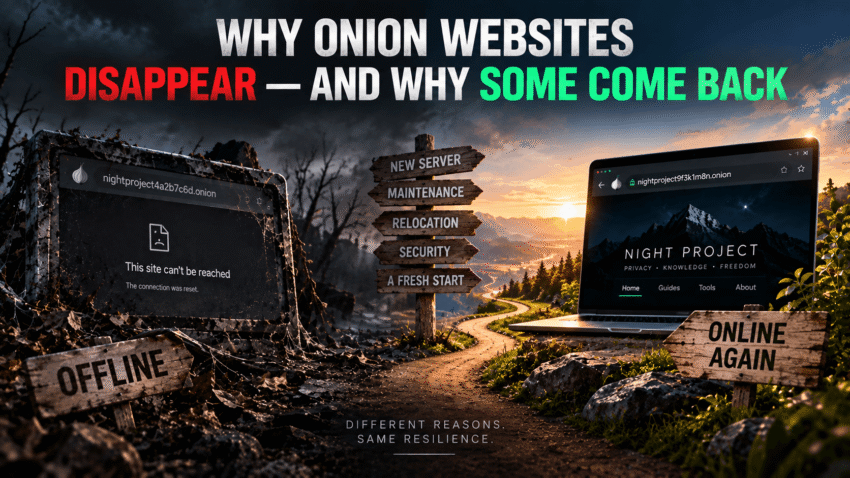
You find an onion website that seems useful, save the address, and visit it occasionally.
Then one day, it stops loading.
You try again the next day. Nothing. A week later, the result is the same. Eventually, you assume the website is gone.
Then something strange happens.
Months—or perhaps years—later, the onion address starts working again.
It may even look familiar. The same name appears. Some of the old content is there. From the outside, it can seem as though a website disappeared from the dark web and suddenly returned from the dead.
But what actually happened?
The answer becomes easier to understand once you stop thinking of an onion website as a normal domain attached permanently to one server.
Onion Services have their own identities, infrastructure, cryptographic keys, and operators. Those pieces don’t always disappear at the same time.
A website can go offline while parts of its identity survive.
And sometimes, that is enough for it to return.
Disappearing From Tor Doesn’t Always Mean Being Deleted
When a normal website fails to load, we often assume something is temporarily wrong.
The hosting company might be experiencing problems. The server could be undergoing maintenance. DNS settings may have changed. A technical mistake could also take the site offline.
Yet people often treat onion websites differently.
When an onion address fails, the immediate reaction is often: the site is dead.
That conclusion can be premature.
Tor itself lists several reasons an Onion Service may fail to load. The service could be offline, busy, or temporarily unreachable. The Tor network may also be experiencing congestion. A connection can even time out while the service itself still exists.
This creates an important distinction:
A website being unreachable is not the same as the website being permanently gone.
Imagine that someone runs an Onion Service from a server they control. They shut that server down for six months.
During those six months, visitors see nothing.
From their perspective, the site has disappeared.
But the operator may still have the website files, database, configuration, and Onion Service credentials stored elsewhere. If the infrastructure returns, the service may return too.
The disappearance was real.
It just wasn’t necessarily permanent.
An Onion Address Is More Than a Normal Domain Name
This is where Onion Services become particularly interesting.
With a regular website, someone might register a domain such as example.com. DNS then helps direct visitors toward the infrastructure hosting that website.
A modern .onion address works differently.
Tor’s specification defines a v3 onion address using information that includes the Onion Service’s Ed25519 public identity key, a checksum, and a version value. The result is encoded into the familiar long onion address.
In simpler terms, the address has a cryptographic relationship with the Onion Service’s identity.
That’s why today’s onion addresses look like long strings of seemingly random characters.
A current v3 address contains 56 letters and numbers before .onion.
That difference becomes important when an onion website disappears.
The computer hosting the website and the identity of the Onion Service are not exactly the same thing.
A server can fail.
A hard drive can be replaced.
A website can move to different infrastructure.
Yet an operator who has preserved the necessary Onion Service keys may still preserve the service’s identity.
Tor’s own setup documentation makes this connection clear. The Onion Service directory contains the service’s hostname and cryptographic keys. Tor also recommends backing up the private key when an operator intends to keep a service available for a long time.
That brings us to the interesting part.
What Has to Survive for the Same Onion Address to Return?
Suppose an Onion Service disappears today.
Could exactly the same address appear again several years from now?
Potentially, yes.
The important piece isn’t keeping the original physical server running in a cupboard for years. It’s preserving the cryptographic identity needed for that Onion Service.
Tor’s specifications describe the Onion Service name in terms of its long-term identity key. Tor’s control specification also notes that if a generated private key is deliberately discarded, the corresponding Onion Service cannot later be recreated from that keypair.
This gives us a useful way to imagine what might happen.
An operator runs an onion website in 2026.
Later that year, the project shuts down. The server goes offline, but the operator keeps backups of the website and the Onion Service’s necessary private material. This is also why protecting and preserving Onion Service keys matters when a service is intended to remain available over time.
Nothing happens in 2027.
Nothing happens in 2028.
To everyone else, the website appears dead.
Then in 2029, the operator decides to revive the project. New hardware can host the website. The content can come from backups, and the preserved Onion Service identity can be used again.
Visitors who still have the old address could suddenly discover that it works.
The server may be new.
The operating system may be new.
The website itself may have changed.
Yet the onion identity can provide continuity.
That’s one reason an onion website can seemingly return from nowhere.

The Server Can Die Without Taking the Website’s Identity With It
Think about a website as several separate pieces rather than one object.
There is the content visitors see.
There is the web server delivering that content.
There is the infrastructure running Tor.
There are databases and other application components.
And there is the Onion Service identity.
Losing one part doesn’t necessarily mean losing everything.
A failed server can be replaced. Website files can be restored from backups. Databases can be moved. Network connections can change.
The Onion Service itself communicates through Tor rather than exposing its location directly to visitors. Tor describes a process involving introduction points, service descriptors, and a rendezvous point that connects the client and service through anonymous circuits.
That architecture separates the public onion identity from a conventional public-facing server location in an important way.
So an onion website’s disappearance may tell you very little about what happened behind the scenes.
Maybe the server failed.
Maybe the operator intentionally shut it down.
Maybe the website moved.
Maybe the project was archived.
Or perhaps the operator plans to restore it later.
From the outside, all of these situations can produce roughly the same experience:
The onion address doesn’t load.
Why Would Someone Intentionally Disappear?
Technical failure isn’t the only reason Onion Services vanish.
Sometimes going offline is a deliberate decision.
Consider a small privacy project maintained by two volunteers.
At first, they have enough time to maintain it. Later, work and personal commitments take priority. Updates slow down, server bills continue arriving, and eventually they decide to shut the service down.
The project hasn’t necessarily been destroyed.
It has simply stopped operating.
A research organization could face a different situation. It may need to rebuild infrastructure or change how a service operates.
Other projects may be temporary by design.
An Onion Service might exist for a particular event, publication, research project, or community. Once that purpose ends, keeping the server online may no longer make sense.
Security concerns can also affect availability.
If operators believe infrastructure has been compromised, they may choose to stop a service rather than continue operating it under uncertain conditions.
And sometimes the explanation is much less dramatic.
People lose interest.
A huge amount of the internet has disappeared for exactly that reason. Someone starts a project with enthusiasm, maintains it for a while, and eventually moves on.
The dark web is not exempt from ordinary human behavior.
Sometimes the Website Returns With a Completely Different Address
Now we need to separate two situations that often get mixed together.
Imagine a website called Example Project disappears.
Two years later, Example Project returns.
That statement alone doesn’t tell us whether its old onion address returned.
The operators might instead launch a new Onion Service with a new identity and therefore a different address.
To a regular visitor, the project has returned.
Technically, however, the old onion address may remain dead.
This distinction became especially visible when Tor moved away from the older v2 Onion Services.
Old v2 addresses were only 16 characters long. Modern v3 addresses use 56 characters. Tor removed support for v2 services in 2021, so operators who wanted to continue needed to move to v3.
That migration created an interesting historical problem.
A website could continue to exist while its old address became permanently obsolete.
Years later, someone might discover an old article containing the v2 address and conclude that the website disappeared.
Meanwhile, the project could be operating elsewhere.
This is why the website, project name, and onion address should not always be treated as interchangeable.

A Familiar Name Doesn’t Prove the Original Website Returned
This distinction becomes even more important when a service reappears under a different address.
Suppose a well-known onion website disappears for three years.
Then a new Onion Service appears using exactly the same name and branding.
Has the original website returned?
Maybe.
But the name alone doesn’t prove it.
The new service could belong to the original operators. Another group might have legitimately revived an abandoned project. Someone could also be using a familiar name without any connection to the original service.
Imitation creates another possibility.
A copycat could reproduce an old website’s appearance and present itself as the returning original.
This isn’t a problem unique to Tor. Impersonation happens across the regular internet too.
But long onion addresses make recognition especially difficult. Tor’s own research documentation notes that these addresses are difficult to type and memorize.
Most people aren’t going to remember a 56-character onion address from several years ago.
They are much more likely to remember the website’s name.
That creates room for confusion.
A familiar website name and a familiar-looking homepage do not, by themselves, establish continuity with an older Onion Service.
Old Onion Addresses Have an Afterlife
Here’s another strange part of the story.
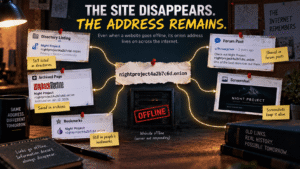
The website can disappear while its address remains everywhere.
Imagine an Onion Service launches and becomes reasonably well known.
A directory lists it.
Someone writes a blog article mentioning it.
Another website copies that information.
Users bookmark the address. People discuss the service online. Screenshots appear. Archived pages preserve references to it.
Discovery works differently inside Tor as well. Traditional search engines struggle to crawl and index Onion Services in the same way they handle ordinary websites. We explain why search engines struggle to index the dark web in more detail in our separate guide.
Then the actual Onion Service disappears.
All those references don’t automatically vanish.
The server may be gone within minutes while the address continues circulating for years.
This is one reason the dark web accumulates so many outdated addresses.
We explored this problem in our earlier article about why the dark web has so many dead links. Old directories and articles can continue distributing addresses long after the services behind them stop responding.
But there’s an interesting reverse effect too.
Those old references can preserve knowledge that a service once existed.
If the same Onion Service genuinely returns years later, people may already have its address saved.
In other words, outdated information can sometimes become current again.
That’s a strange characteristic of an ecosystem where an address can remain known during years of inactivity.
Coming Back Doesn’t Always Mean Picking Up Where Things Left Off
Suppose an onion website genuinely returns after several years.
Even then, visitors shouldn’t assume everything is exactly as it was before.
The infrastructure may have changed.
The people maintaining the project may have changed.
Old content might be missing. Policies could be different. The software behind the service may have been rebuilt.
A revived website is therefore better understood as a continuation that needs fresh evaluation, rather than a frozen website suddenly waking up.
This matters because time creates uncertainty.
On the normal web, we see similar situations when abandoned domains change ownership. A domain that hosted one project five years ago may host something completely unrelated today.
Onion addresses work differently from purchased DNS domains, but the broader lesson still applies:
History doesn’t automatically tell you what a website represents today.
What If the Old Onion Address Suddenly Starts Working Again?
This is probably the most interesting scenario.
You have an old onion address in your bookmarks.
It hasn’t worked for two years.
Then one evening, it loads.
What does that actually prove?
At the most basic level, it tells you that an Onion Service associated with that address is reachable again.
Tor’s cryptographic design helps clients verify that they are communicating with the Onion Service associated with the requested address. The Tor Project describes this as one of the security properties of .onion URLs.
But people often make a much larger assumption:
“The same people must be running it again.”
That conclusion requires more evidence.
Cryptographic continuity of an Onion Service is important, but it doesn’t tell an outside visitor everything that happened during the years the website was offline.
Organizations change.
Projects can change hands.
Credentials can be transferred or compromised.
Teams can gain or lose members.
A service’s identity can therefore tell us something useful about technical continuity without answering every question about organizational continuity.
That’s an important difference.
“It Came Back” Can Be Surprisingly Difficult to Prove
This is where language matters.
There are several very different events that people may describe with the same phrase:
“The onion site came back.”
Perhaps the exact onion address became reachable again.
Perhaps the original project launched a new onion address.
Perhaps a successor revived the project’s name.
Perhaps somebody created an unofficial replacement.
Or perhaps a completely unrelated operator copied the branding.
Those aren’t equivalent situations.
When a project provides official public channels, signed announcements, documented migration information, or other established methods of verification, those can provide additional context.
Without that evidence, certainty may be difficult.
This is particularly important after a long absence.
A website disappearing for two hours is ordinary downtime.
A website disappearing for three years creates a much larger gap in its history.
The longer that gap becomes, the more reasonable it is to ask what exactly has returned.

Not Every “Dead” Onion Website Is Actually Dead
There’s another reason this subject becomes confusing.
Sometimes nothing dramatic happened at all.
Tor Browser distinguishes between several connection problems. An Onion Service may be offline, overloaded, require authentication, or experience a circuit timeout. Tor recommends trying again later when temporary connection problems are possible.
That means checking an onion address once isn’t enough to establish that it has permanently disappeared.
Even several failures don’t tell you the future.
A small service could experience unreliable hosting for days. An operator could intentionally take it offline during maintenance. A technical problem could take weeks to resolve.
Then the site returns.
To someone checking occasionally, it may look like a disappearance and revival.
To the operator, it may simply have been a frustrating server problem.
This is why “currently unreachable” is often more accurate than “permanently dead.”
There is no universal timer after which an unavailable Onion Service officially becomes dead.
Why Some Onion Websites Never Return
Of course, many disappearances really are permanent.
An operator can shut down a project and delete everything.
Hardware can fail without backups.
Important cryptographic material can be lost.
Organizations can dissolve.
A service may be deliberately retired.
And if the necessary private identity material no longer exists, recreating the exact same Onion Service identity is not simply a matter of choosing the old address again. Modern onion addresses derive from cryptographic identity information rather than being ordinary names an operator registers.
That is a major difference from conventional domains.
If you lose control of a regular web server but still control your domain, you can point that domain toward replacement infrastructure.
With an Onion Service, preserving the relevant cryptographic identity matters.
Without it, a revived project may need a new Onion Service identity and therefore a new address.
So some onion websites disappear and truly never come back.
Their addresses become historical artifacts.
The Strange Afterlife of Onion Websites
An onion website doesn’t always have a clean beginning and ending.
It can launch, disappear, return briefly, disappear again, move to another address, or eventually reappear years later.
And different parts of the service can survive for different lengths of time.
The server can disappear while backups remain.
The website can disappear while its name remains familiar.
The infrastructure can change while the Onion Service identity survives.
A project can continue while its old address becomes obsolete.
Or an address can return while questions remain about what changed during its absence.
That’s why why onion websites disappear is more complicated than simply asking whether their servers are online.
The Tor network gives Onion Services properties that ordinary websites don’t have. Their locations can remain hidden, their addresses have a cryptographic relationship with their identities, and clients reach them through Tor’s introduction and rendezvous system.
Those properties help explain something that can otherwise look mysterious.
A website doesn’t need to remain continuously online for every part of its identity to survive.
Sometimes an outage lasts minutes.
Sometimes a project disappears permanently.
And occasionally, an address that seemed to belong to the past starts responding again.
When that happens, the most interesting question isn’t simply:
“Is the website back?”
It’s:
“What, exactly, came back?”