
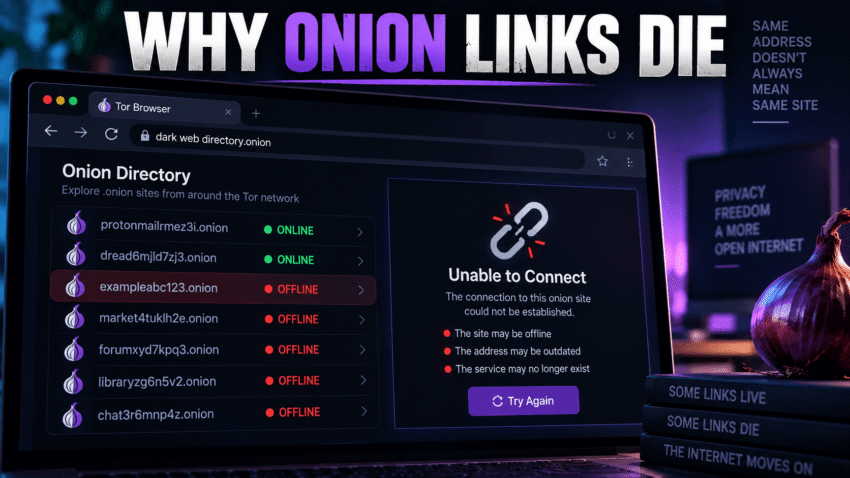
A Working Onion Address Can Suddenly Lead to Nothing
If you have ever explored onion sites through Tor Browser, you have probably experienced this. You find an onion link that looks active, open it, wait for it to load—and nothing happens.
Maybe Tor Browser tells you that the site cannot be reached. Maybe the connection keeps failing. What makes it more confusing is that the same link may have worked perfectly a few days or months ago.
So, does that mean the website is dead?
Not necessarily.
We see similar situations on the regular web. A website can temporarily disappear because its server goes down. Hosting problems, DNS issues, expired SSL certificates, maintenance, or simple technical errors can make a normal website unavailable. Fix the problem, and the website may come back online.
Onion sites can also experience ordinary server and hosting problems. However, there is more happening behind the scenes.
A .onion address works differently from a normal domain. The service relies on the Tor network and its own cryptographic identity. Some onion sites also operate for relatively short periods. Others change addresses, lose their infrastructure, or simply disappear when their operators stop maintaining them.
Directories may still list it. Old articles may still mention it. People may have saved it in bookmarks, and other websites may continue copying the outdated address.
That is how you can end up clicking an onion link for a website that no longer exists.
But even then, calling every unreachable onion address a “dead link” can be misleading. Some services disappear permanently, while others are only offline for a few hours or days.
So why does this happen so often on the dark web? And how can an onion address keep circulating long after the website behind it has disappeared?
To understand that, we first need to look at what makes an onion site different from a normal website.
1. Onion Sites Don’t Work Like Normal Websites
Onion sites may look similar to regular websites, but they work differently behind the scenes. You cannot reach a .onion address through a normal internet connection. Instead, you need to connect through the Tor network.
An Onion Service does not simply expose its location like a conventional website. It creates several introduction points within the Tor network. It then publishes information that allows Tor clients to learn how to contact the service.
When someone visits the onion address, Tor helps the client and the service establish a connection. They eventually communicate through what Tor calls a rendezvous point. This process allows the service to operate without revealing its network location to the visitor.
This design provides important privacy benefits. However, it also means that reaching an onion site depends on more than a traditional domain pointing to a web server.
If part of that process fails, the site may become unreachable. That does not always mean the onion address has disappeared permanently.
2. Many Onion Sites Are Independently Operated
The regular web includes millions of small websites, but it also has huge platforms with professional infrastructure. Large companies can employ teams to maintain servers, monitor downtime, and fix technical problems.
Many Onion Services operate on a much smaller scale.
An individual, researcher, organization, or small team may run an onion site. Some projects have reliable infrastructure and remain online for years. Others may depend on only a few people and limited resources.
That difference matters when something goes wrong.
An operator might shut down a server or stop maintaining the project. Hosting or hardware problems can also cause extended downtime. In other cases, the people behind a service simply decide that they no longer want to run it.
Some operators also take their services offline intentionally. They may later restore them, move them, or abandon them completely.
Once the service stops operating, its onion address can become unreachable. However, copies of that address may remain elsewhere on the internet.
An old directory may still list it. A blog post may continue linking to it. People may also have the address saved in bookmarks or shared in older discussions.
As a result, the website can disappear long before its address stops circulating.
This is one of the main reasons people continue to encounter dead onion links years after the original services have gone offline.

3. An Onion Address Depends on Cryptographic Identity
A modern onion address is more than a name chosen for a website. It has a direct connection to the cryptographic identity of the Onion Service.
This makes .onion addresses very different from ordinary domain names.
With a regular website, an owner can point the same domain to a new server. The website may change hosting companies or move to new infrastructure. Visitors can still use the same domain name.
V3 onion addresses work differently. Tor creates the address using information connected to the service’s public identity key. The address also includes a checksum and a version value.
This design helps Tor verify that users are connecting to the service associated with that onion address.
It also means an operator cannot treat an onion address exactly like a normal domain. If a service loses or replaces the cryptographic keys tied to its identity, keeping the same address becomes a problem.
The operator may need to start a service with a new onion address instead. Meanwhile, the old address can remain in directories, articles, bookmarks, and online discussions.
To someone who later finds that old address, it simply looks like another dead link.
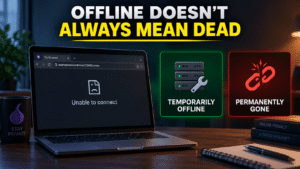
4. Sometimes the Website Isn’t Dead — It’s Temporarily Offline
Seeing an error in Tor Browser does not prove that an onion site has disappeared forever.
Sometimes the service is simply unavailable at that moment.
The server could be undergoing maintenance. It could have lost its internet connection or experienced a technical problem. The operator might also have taken the service offline for a short period.
Tor itself adds another layer to this situation.
Onion Services normally use introduction points so clients can begin the process of connecting to them. However, Tor’s specification allows a service descriptor to contain no introduction points.
In that situation, the service can still exist while refusing new client connections.
This creates an important distinction when talking about dead links:
Unreachable does not always mean permanently dead.
A link that fails today might work again tomorrow. Another may stay unavailable for weeks and eventually return. Some services, of course, never come back.
From the outside, it can be difficult to know which situation applies. That uncertainty is one reason counting “dead” onion sites is not as simple as checking each address once.
5. Some Onion Services Move to New Addresses
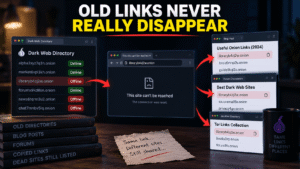
An onion site does not always disappear because its operators shut it down. Sometimes the service simply moves to a new address.
An operator may retire an existing Onion Service and launch a replacement. Technical changes can also lead to a new address. In some cases, the operator may choose to start again with a new cryptographic identity.
The problem is that the old address does not automatically disappear from everywhere else.
It may remain in articles, directories, forum discussions, social posts, and personal bookmarks. Search results on the regular web can also preserve pages that mention the outdated address.
Meanwhile, the actual Onion Service may continue operating at its new location.
Anyone who finds the previous address will see an unreachable site. Without knowing about the replacement, that person may assume the entire service has disappeared.
Over time, several old addresses for the same service can circulate online. This makes it even harder to distinguish a truly abandoned site from one that has simply moved.
6. Old Directories Keep Dead Links Circulating
Outdated directories are another major reason dead onion links remain easy to find.
A directory may add an address while the Onion Service is active. Months or years later, the service might shut down or move elsewhere. Unless someone checks the listing again, the old address can remain on the page.
The problem can then spread beyond the original directory.
Other websites sometimes collect addresses from existing lists. Articles and online discussions may reference those same sources. As more pages repeat an outdated address, it can continue circulating long after the original service disappears.
The pattern is fairly simple:
A service launches → directories list it → the service disappears → the listing remains → other sources repeat the old address.
This also explains why the age of a directory does not always tell you how current its listings are. A website can publish new content while leaving older entries untouched.
Maintaining an onion directory therefore requires more than adding new addresses. Publishers need to review existing listings periodically and remove or clearly mark services that no longer respond.
Even then, checking an address once cannot always provide a definitive answer. As discussed earlier, an Onion Service may experience temporary downtime and return later.
That leaves directories with a difficult task: keeping their information current without treating every temporary outage as a permanently dead site.
7. Scams and Short-Lived Sites Add to the Problem
Not every dead onion link comes from a technical failure. Sometimes the people behind a site never planned to keep it online for long.
Fraudulent sites are an obvious example. An operator may create a site, collect money or information, and then disappear. Once the operation ends, the onion address stops working.
Impostor sites make the situation even more confusing.
Someone may create a copy of a known onion site and use a different address. The clone might copy the original design, name, and branding. To an unfamiliar visitor, both sites can appear legitimate.
Over time, several addresses may circulate under the same name. Some belong to old versions of the service. Others may belong to clones or unrelated operators.
When those sites disappear, their addresses can remain in old directories and discussions. This adds another layer of dead links to an already difficult ecosystem.
The important point is that an onion site does not always disappear because something broke. Sometimes its disappearance was intentional from the beginning.
8. Law Enforcement Can Take Individual Services Offline
Tor itself is a network, so taking down one onion site does not mean shutting down the dark web.
Law-enforcement agencies can instead investigate specific services, their operators, or the infrastructure behind them. When authorities identify that infrastructure, they may seize servers and other assets as part of an investigation.
History provides several clear examples.
In 2017, an international operation targeted AlphaBay, then a major criminal marketplace operating through Tor. U.S. authorities said the operation seized AlphaBay’s infrastructure. Agencies from several countries took part in the investigation.
The operation also targeted Hansa Market. Dutch authorities investigated and took control of that marketplace as part of the coordinated effort.
An earlier international operation in 2014 targeted dozens of criminal dark-web markets. The U.S. Department of Justice reported the seizure of more than 400 .onion addresses, along with associated servers.
These cases show an important distinction. Law enforcement does not need to shut down Tor to make a particular onion address disappear.
Authorities can target an individual service when an investigation identifies its operators or supporting infrastructure. After a seizure, an address may stop working or display a seizure notice.
Years later, however, that same address may still appear in an old article, directory, or discussion.
To someone discovering it today, it looks like another dead onion link. The reason behind it has little to do with ordinary server downtime.
9. The Move From V2 to V3 Left Many Old Onion Links Behind
Another reason for dead onion links comes from a major change in Tor’s history.
For years, Tor supported an older generation of Onion Services known as v2. Their onion addresses were much shorter than the addresses people see today.
Tor later introduced v3 Onion Services with stronger cryptography and several security improvements. A v3 onion address contains 56 characters before the .onion ending. Its design also connects the address to the service’s cryptographic identity.
Eventually, Tor retired the older v2 system. Tor Browser stopped supporting v2 Onion Services in 2021, making those old addresses unusable with modern versions of Tor.
The services themselves had to migrate if their operators wanted to remain accessible. That meant moving to new v3 addresses.
However, the old v2 addresses did not disappear from the wider web.
Many remained inside old articles, directories, forum discussions, archived pages, and bookmarks. Some of those pages still exist today.
As a result, someone reading an old resource can find an onion address for a service that once genuinely worked. The link is now permanently obsolete, even if that same service later continued under a v3 address.
This transition added a large collection of historical onion addresses that modern Tor clients can no longer use.

10. Why Google Can’t Simply Clean This Up
On the regular web, search engines constantly crawl websites and update their indexes. That process helps them discover new pages and notice when old ones disappear.
Onion Services create a different situation.
Google does not function as a comprehensive crawler and index of the Tor network. Onion sites may also exist without links from the public web that a conventional search engine can discover.
We’ve previously looked at how search engines interact with the dark web, including why traditional crawlers struggle to discover and index Onion Services.
This means Google cannot simply crawl every onion address, determine which services still exist, and remove every outdated address from third-party pages.
The problem becomes especially noticeable with old directories and articles. A normal webpage may remain indexed even when the .onion address written on that page stopped working years ago.
As we explained in [How Search Engines Cannot Index the Dark Web], finding current onion services works differently from finding ordinary websites.
That difference helps old addresses survive online. The Onion Service can disappear, while references to its address remain searchable for years.
11. How Can You Tell Whether an Onion Link Is Really Dead?
A failed connection does not always mean an onion site has disappeared permanently.
Onion Services can experience temporary downtime just like websites on the regular web. The operator may be performing maintenance or dealing with a server problem. Network issues can also make a working service unavailable for a period of time.
For that reason, it helps to separate two different situations.
A temporarily unreachable service still exists but cannot accept connections at that moment. It may return later without changing its onion address.
An abandoned or retired service is different. Its operator may have shut it down permanently, replaced it, or stopped maintaining the infrastructure behind it.
From a visitor’s perspective, both situations can look almost identical. Tor Browser cannot tell you whether an unavailable service will return next week.
Time can provide more context. If an address remains unreachable over an extended period, it becomes more reasonable to consider it inactive. However, there is rarely a simple way for an outside observer to prove that an operator will never bring the service back.
This uncertainty also creates a challenge for directories. Removing every address after one failed connection could remove services experiencing temporary downtime. Leaving addresses untouched for years creates the opposite problem.
So, when an onion link fails, “currently unreachable” is often more accurate than immediately calling it permanently dead.

12. Why Dead Links Will Probably Always Be Part of the Dark Web
Dead links are unlikely to disappear completely from the dark web.
Onion Services operate differently from conventional websites. Some remain online for many years, while others have much shorter lives. Operators can retire projects, move services, change addresses, or simply stop maintaining them.
Old addresses can then survive long after the services behind them disappear.
Directories may continue listing them. Articles can preserve them for years. Old discussions and archived pages can also keep those addresses circulating across the regular web.
The history of Tor adds another layer. The transition from v2 to v3 left many obsolete addresses behind. Law-enforcement actions have removed individual services, while scams and temporary projects have created even more abandoned addresses.
None of this means that Tor itself has stopped working.
Tor designed Onion Services to provide services that users can access through the Tor network. They can support websites and other privacy-focused applications while protecting the network locations of both sides of the connection.
That privacy-focused design comes with an ecosystem that does not behave exactly like the conventional web.
A dead onion link can have many explanations. The server may be down temporarily. The operator may have abandoned the project. The service may have moved to another address, or the address itself may belong to an older generation of Tor.
Meanwhile, references to that address can remain online indefinitely.
That is perhaps the simplest explanation for why dead links remain so common: onion sites can disappear much faster than their addresses do.